Create an Entity
Overview
This document describes how to create an entity in any work system using the SyncNow DevOps Gate. You can use Groovy scripts for Jenkins or copy cURL commands directly from the DevOps Gate project configuration in the SyncNow UI.

💡 Usage Examples
- Create a bug when automated testing fails.
- Create a bug when a security vulnerability is found.
- Create a service ticket when an incident is identified in another system.
✨ Creating an Entity
This procedure creates an entity according to the mapping definition. If an entity with the same title/summary or matching a defined filter exists, SyncNow will update it instead of creating a duplicate.
📨 API Request
The request URL should include the system ID, which can be copied from the DevOps Process definition page.
POST /api/v1.0/DevOpsGate/Enrich/{DevOpsProjectID}?action=create
Request Body Parameters:
| Parameter | Description |
|---|---|
| Param1…ParamX | Parameters as defined in the DevOps Gate per entityType mapping |
subProject | The target work system project as defined in the DevOps Gate Process. Work systems for publishing can be limited through SyncNow DevOps Process configuration |
entityType | The entity to be created |
CreateIfEntityDoesNotExistByTitleOtherwiseUpdate | Whether to create an entity if found a similar one with the same title |
Sample Payload:
[
  {
    "fields": [
      { "key": "Param1", "value": "string" },
      { "key": "Param2", "value": "string" },
      { "key": "Param3", "value": "string" }
    ],
    "subProject": "MyProject",
    "entityType": "Bug",
    "CreateIfEntityDoesNotExistByTitleOtherwiseUpdate": "false"
  }
]
🟢 API Response
| Field | Description |
|---|---|
| systemID | The system where the entities were created |
| entityKeys | The IDs of the entities created |
| errors | Errors that occurred during creation |
| warnings | Warnings that occurred during creation |
Sample Response:
{
  "updatedEntitiesID": [
    {
      "systemID": "10",
      "entityKeys": ["CLS-3938"]
    }
  ],
  "errors": [],
  "warnings": []
}
🤖 Jenkins Groovy Script Example
Below is a Groovy code example for Jenkins that creates an entity with SyncNow DevOps Gate:
@NonCPS
def getCommentsString() {
    def list = []
    def changeLogSets = currentBuild.changeSets
    for (int i = 0; i < changeLogSets.size(); i++) {
        def entries = changeLogSets[i].items
        for (int j = 0; j < entries.length; j++) {
            def entry = entries[j]
            if (entry.msg != null) {
               list.add("""${entry.commitId} on ${new Date(entry.timestamp)}: ${entry.msg.replaceAll("[\n\r]", " ")}""")
            }
        }
    }
    return list.join(',')
}

pipeline {
    agent any
    stages {
        stage('Clone') { steps { echo 'Clone Code' } }
        stage('Version') { steps { echo 'Version' } }
        stage('Test') { steps { echo 'Test' } }
        stage('Build') { steps { echo 'Build' } }
        stage('Publish') { steps { echo 'Publish' } }
        stage('Notify SyncNow') {
            steps {
                echo 'Notify'
                echo "Job Name is ${JOB_NAME}, Build ID is ${env.BUILD_ID}"
                script {
                    def commits = getCommentsString()
                    def payload = """
[{
  "fields": [
    { "key": "Param1", "value": "string" },
    { "key": "Param2", "value": "string" },
    { "key": "Param3", "value": "string" }
  ],
  "subProject": "MyProject",
  "entityType": "Bug"
}]
                    """
                    def response = httpRequest acceptType: 'APPLICATION_JSON', contentType: 'APPLICATION_JSON', httpMode: 'POST', authentication: 'SyncNow', requestBody: "${payload}", url: "https://<SyncNowBaseURL>/api/v1.0/DevOpsGate/Enrich/<DevOpsProjectID>?action=create"
                    println("Status: ${response.status}")
                    println("Content: ${response.content}")
                }
            }
        }
    }
}
📝 Step-by-Step Instructions
Example: Create or Update an Entity
-
Create a DevOps Gate Process.
-
Navigate to the Mapping Entities page.
-
Go to the Mapping Options page for specific entity mappings.

-
Add filters (e.g., filter by Status).
Duplicate Detection: Entity names are always checked by their summary/title. If an entity with the same name/title and type is found, it will be updated.

-
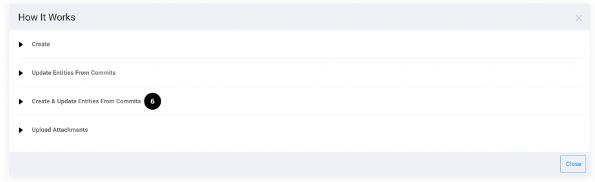
Go to the DevOps Gate Process Configuration and press the How It Works link.

-
Select "Create & Update Entities from Commits".
-
Copy the cURL command.

-
Paste it into a command line. Set the correct sub-project and execute.

-
Change the content of the fields as needed and execute again.
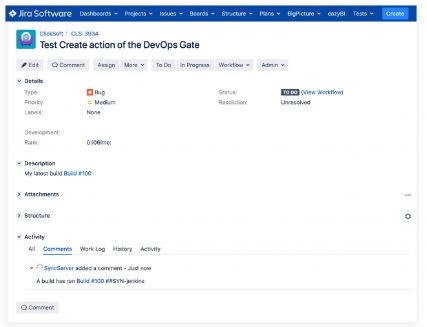
A new entity will be created with information from both DevOps Gate calls.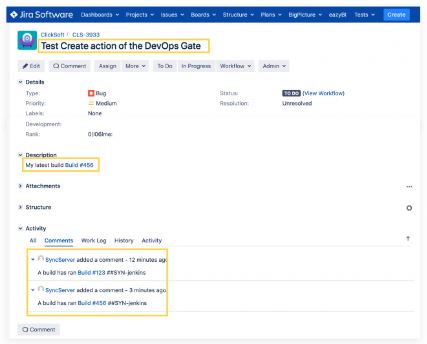
-
Change the status of the entity.

-
Execute the cURL command again.
A new entity will be created.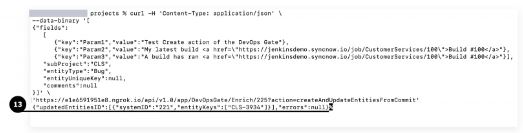
Tip:
Use filters and duplicate detection to avoid creating unnecessary duplicates and to keep your work systems clean and up to date.